50/50 Custody Schedules: Examples, Factors to Consider, Expert Tips, and FAQs

Compare 50/50 custody schedules like 2-2-3, 3-4-4-3, 2-2-5-5 and alternating weeks, get age-based tips from family law attorneys and download free templates.
During a divorce or separation, many co-parents decide to split parenting time equally with a 50/50 custody schedule. In this guide, family law attorneys and a family-law researcher compare 50/50 custody schedules to help you choose the right one for your family.
What is 50/50 custody?
50/50 custody is a joint custody arrangement in which children spend time equally with each parent. This arrangement can benefit the children and co-parents. It can provide stability and deeper bonds with each parent. But the co-parents must coordinate well and live near each other.
50/50 custody, or 50/50 parenting time, has become a familiar way to arrange custody after divorce. Researchers have studied how these arrangements affect children, including a 2018 review by Nicole Mahrer and colleagues in the Journal of Divorce & Remarriage. Their findings suggest results depend heavily on conflict and cooperation between parents, as the research below explains.
In the review published online in 2020 "Children in dual-residence arrangements: a literature review," published in the Journal of Family Studies, Rakel Berman and Kristian Daneback analyze peer-reviewed research on how 50/50 schedules impact families and children. The article summarizes that "there is largely consensus among researchers that children in dual-residence arrangements are equally well, or often better off in several ways (health, risk, etc.) than children living with one parent only."
Attachment theory describes how a child's early relationships with their caregivers affect their emotional and social development. Early attachment theory emphasized a child's bond to a primary caregiver, usually the mother. But a 2021 review in New Directions for Child and Adolescent Development notes that Bowlby never meant a child should ideally have only one attachment figure, and children often form attachments to more than one person.
According to a review in Paediatrics & Child Health, there are four types of infant-parent attachment: Secure, avoidant, resistant and disorganized. Secure attachment is considered a protective factor for children's development.
Children can build a secure attachment with more than one caregiver, and the Paediatrics & Child Health review stresses that each caregiver's sensitive, consistent care matters. These early bonds can shape how children feel about themselves and their relationships as they grow.
But, as with all parenting schedules, the efficacy of shared custody depends on the characteristics of the family. In fact, in the aforementioned 2020 article, the authors describe that expert consensus on the benefits of 50/50 "is only valid when there is no ongoing conflict, if parents are able to cooperate and if children are above the age of four." Also, with any parenting plan, children of appropriate age should have their preferences and opinions heard when deciding on a parenting plan.
 Michael Saini, Ph.D., M.S.W., R.S.W., Professor and Chair in Law and Social Work at the University of Toronto, echoes this sentiment: “The challenge for parents (and professionals who attempt to find the optimal parenting plan for the child) is to not assume a specific plan will always be the best fit. It is important to carve out a plan that could work best for their family circumstances, their child’s ages and stages of development, the relationship of the child with both parents, the practicalities and realities of each parent’s circumstances (e.g. distance between homes)."
Saini continues, "Rather than presume that one plan will be the best plan for their child, parents should consider an individualized assessment of the child’s best interest including the child’s views and preferences.”
 Attorney Ron Lieberman, partner at family law firm Rigden Lieberman Mignogna, P.A. and former chair of the Family Law Section of the New Jersey State Bar Association, notes that the benefits from shared physical custody depend on the situation. "Equal shared physical custody can be worth the investment. Some benefits include more free time for the co-parents, a diverse upbringing, and equal parenting time for the child. But, if the parents live far from each other, travel can be lengthy and disruptive. Also, shared parenting might preclude a younger child from establishing structure with either parent."
Also, the specific emotional significance of splitting time down the middle should not supersede the goal of shared plans: To give children quality time with both parents. The efficacy of 50/50 can be very specific to the situation. Still, 50/50 arrangements can benefit many families, so long as co-parents and anyone else involved firmly believe that the plan prioritizes the child's best interests.
A note on terminology: In general, the term “physical custody” refers to which parent a child lives with. Today, other terms are also common, like “parenting schedule” or “parenting time arrangement.” These new terms better represent a relationship and the parent’s responsibilities for their children. But just a heads up: This article uses these older and newer terms interchangeably.
Key takeaways from this guide:
- Common 50/50 custody schedules suit different family needs and logistics, giving children and parents flexibility and stability.
- The best custody schedule depends on the child’s developmental stage, preferences, and the parents’ ability to minimize conflict and support a secure environment.
- 50/50 schedules work best when parents live close to one another, communicate effectively, and minimize conflict.
- Younger children benefit from frequent exchanges to build secure attachments, while older children and teenagers can adapt to longer intervals.
- Co-parenting apps like OurFamilyWizard help parents track custody schedules, manage communication, and adjust plans flexibly, reducing logistical stress so families can focus on the children’s wellbeing.
Examples of different 50/50 custody schedules
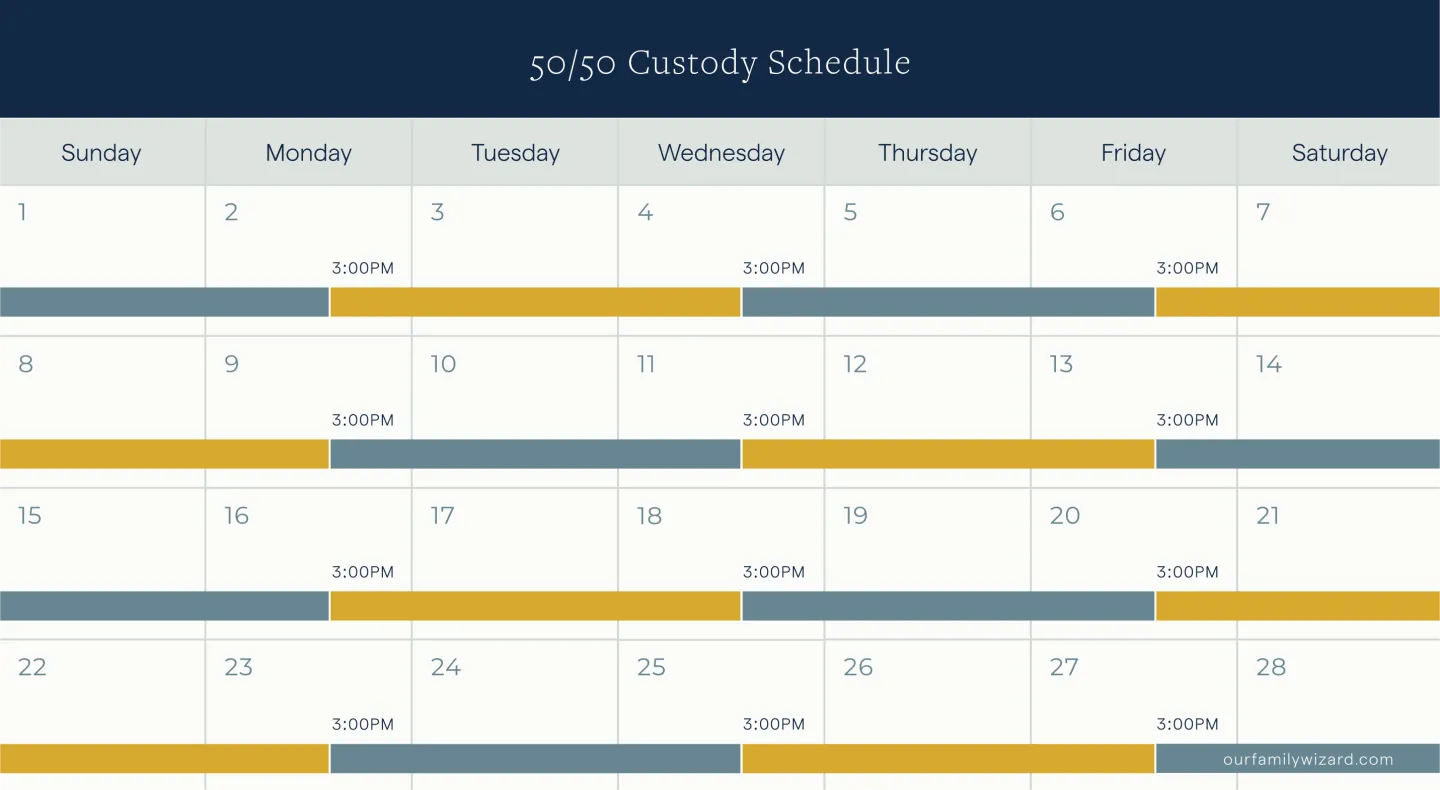
Four of the most common 50/50 custody schedules are 2-2-3, 3-4-4-3, 2-2-5-5, and alternating weeks, and each one moves children between homes at a different pace. Families can choose among them based on the needs of their children and their work schedules. For example, families with older teenagers may enjoy the alternating weeks schedule. On the other hand, families who want frequent exchanges may thrive under 2-2-3.
Here's a list of the most popular 50/50 custody schedules. It includes their benefits, challenges, and a quick overview of the type of family who will thrive under each plan. Of course, a schedule that suits one family perfectly may prove challenging for another.
If you want to see a more customized version of a 50/50 parenting time schedule, your divorce attorney can use OurFamilyWizard's Custody Schedule Builder (available for family law professionals) to quickly and easily show you additional variations.
For the most common arrangements, we've organized the schedules by frequency of child exchanges, starting with the most frequent and ending with the least.
2-2-3 custody schedule
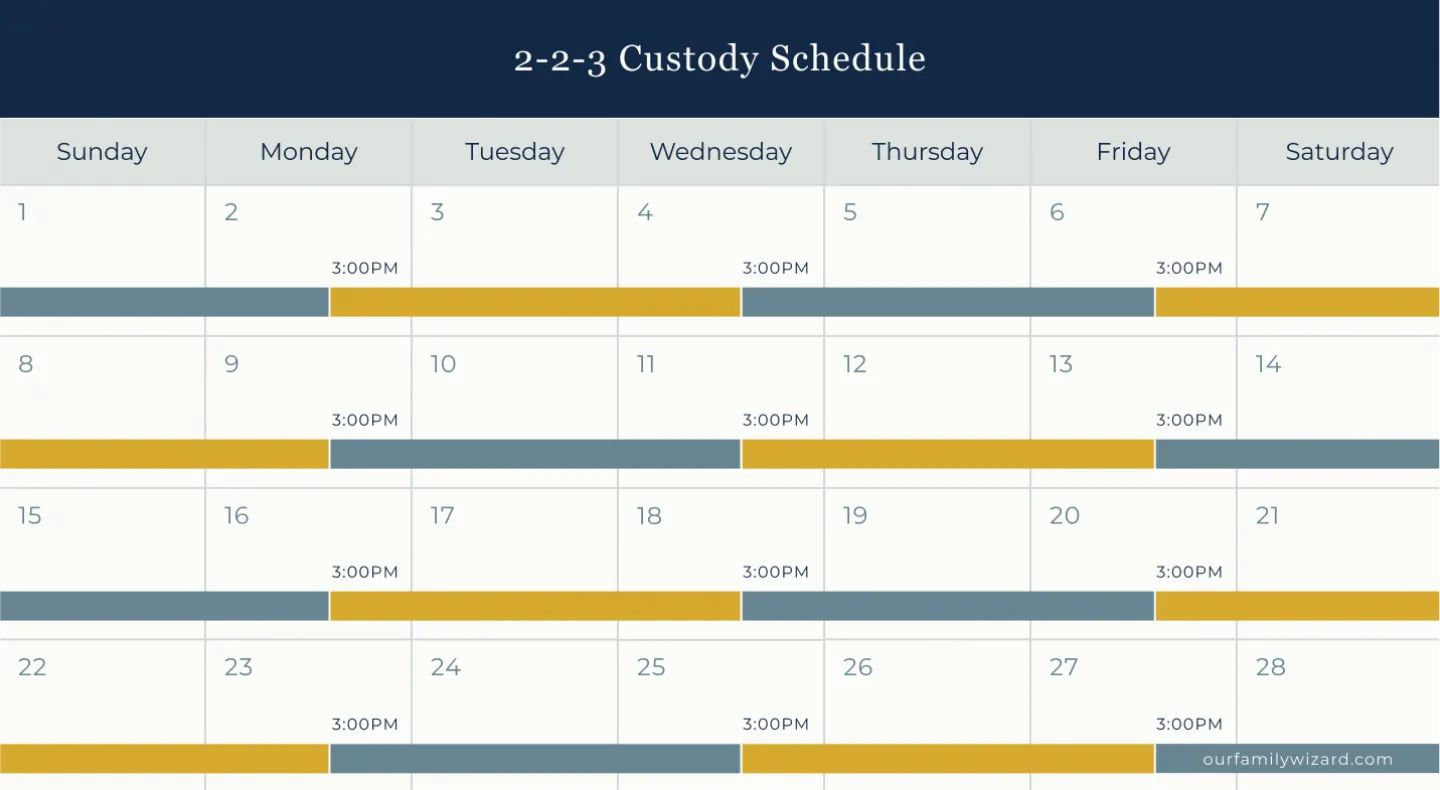
Month view of a 2-2-3 parenting schedule
In the 2-2-3 schedule, the first co-parent spends two days with the children, and then the children go to the other parent for the next two days. Then, the children spend the last three days of the week with the first co-parent. Next week, the parents will swap their days, so each co-parent spends every other weekend with the children.
For example, Maya might spend Monday and Tuesday with Parent A and Wednesday and Thursday with Parent B. She returns to Parent A for Friday through Sunday, and the parents swap days the next week. Over two weeks, each parent has Maya for 7 of 14 days.
The major benefit of this schedule is that co-parents and kids don't spend more than three days apart. The major challenge is handling frequent transitions.
2-2-3 works best for co-parents who live close to one another, since the schedule involves frequent exchanges and transitions. Co-parents must regularly interact, so they should have a relatively tension-free relationship. It also suits younger children, who need time with both parents to form healthy relationships. Attorney Lisa Zeiderman says she often starts very young children on a 2-2-3 schedule.
3-4-4-3 custody schedule
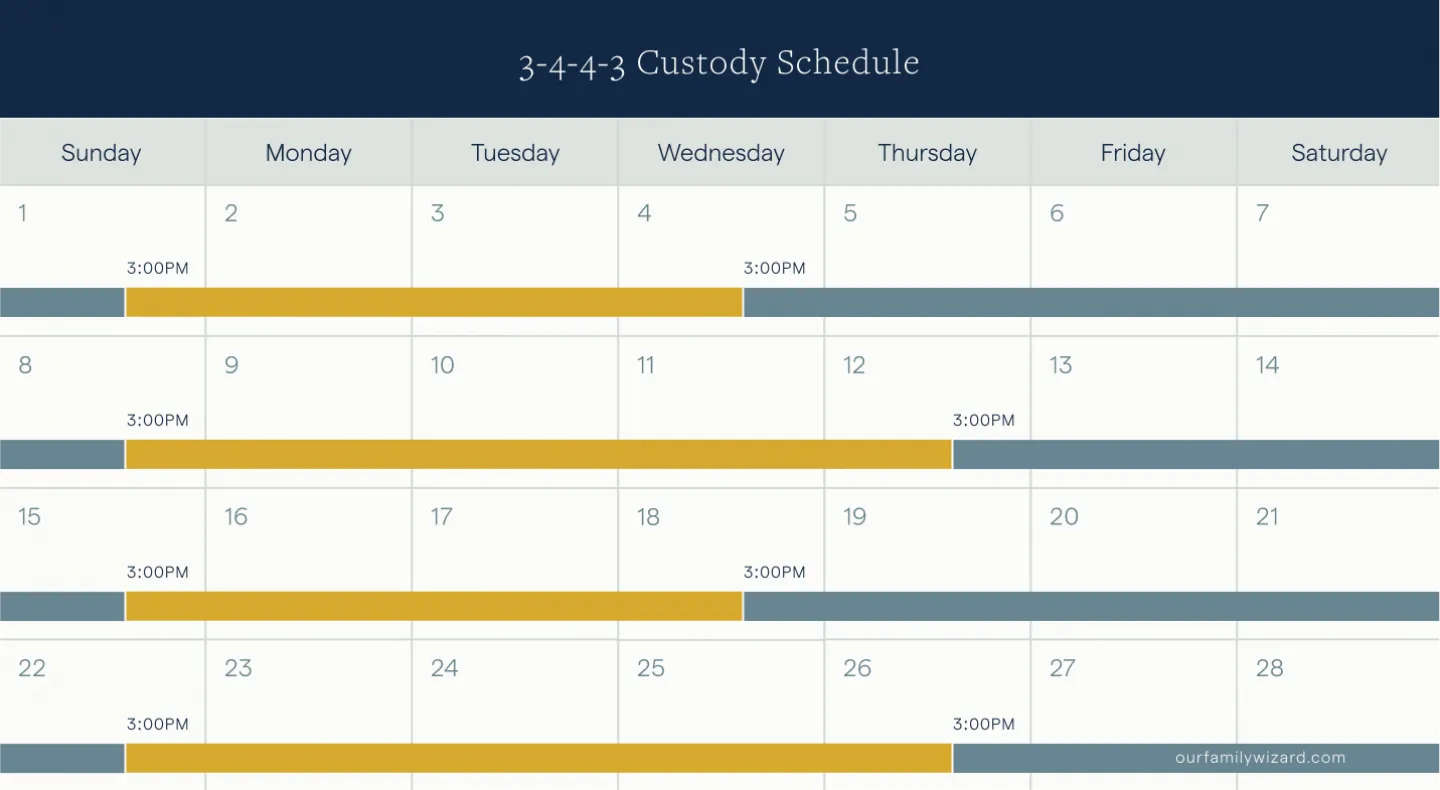
Month view of the 3-4-4-3 parenting plan
The 3-4-4-3 rotation breaks the week up into three- and four-day periods. With the 3-4-4-3 plan, the kids spend three days with one co-parent and then four days with another. Then, co-parents reverse the order: The children go with the first co-parent for four days and the second for three.
For example, Liam might spend Sunday through Tuesday with one parent and Wednesday through Saturday with the other. The next week, the parent who had three days gets four, so each parent has Liam for 7 of every 14 days. Don't confuse this schedule with the 4-3 schedule, which is a 60/40 split.
3-4-4-3 doesn't keep kids apart from either co-parent for too long. The structured plan requires only a single exchange day a week, which helps co-parents structure their free time and creates a schedule that kids can easily remember. In some cases, 3-4-4-3 gives only one parent weekend time, which can be stressful. Also, children may not enjoy swapping homes every week.
3-4-4-3 works best for co-parents with structured schedules who live near one another. It also suits school-age children (kindergarten through 8th grade, per the comparison table below) who need to see both parents regularly.
2-2-5-5 custody schedule
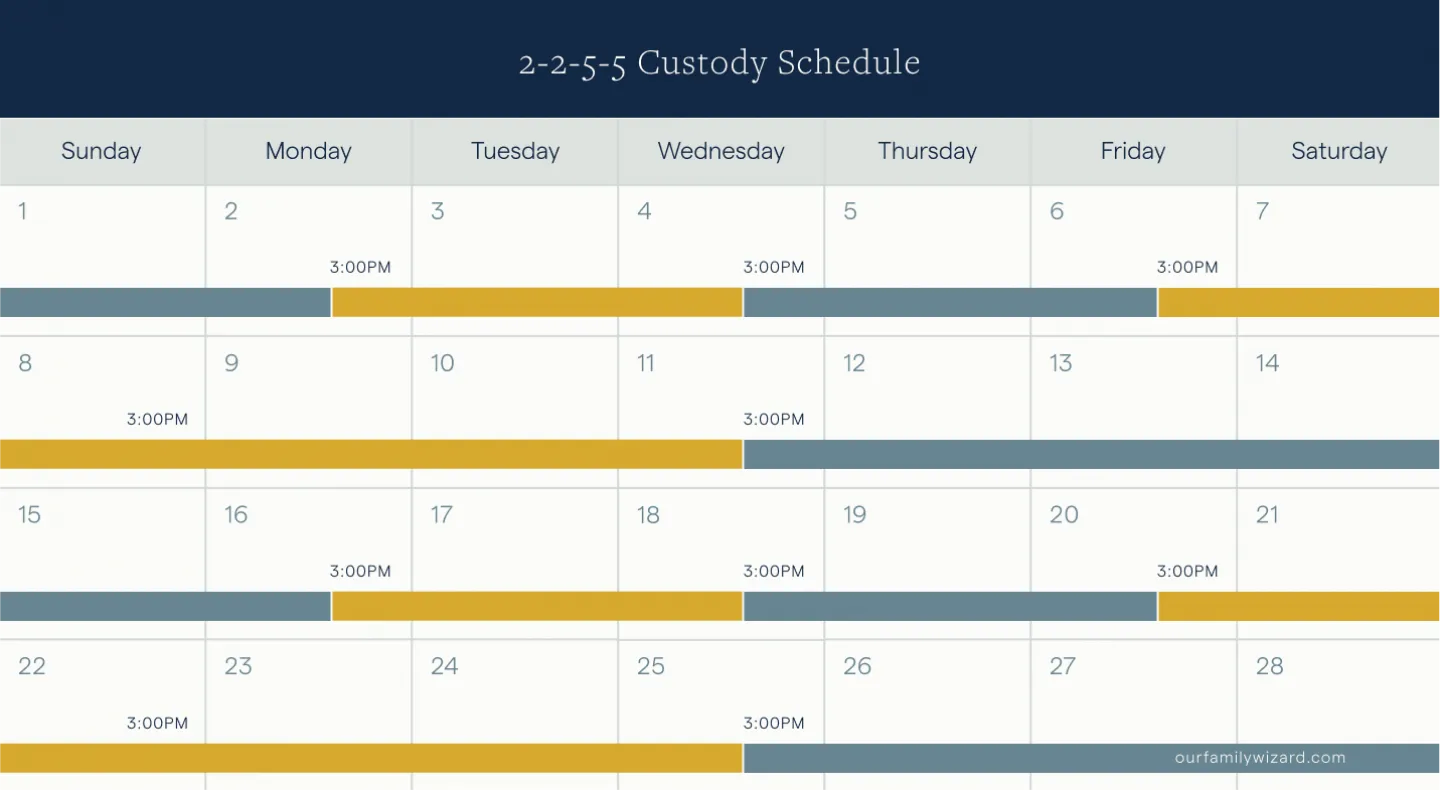
Month view of the 2-2-5-5 parenting plan
Under 2-2-5-5, co-parents split two-week intervals into two- and five-day periods. The child spends two days with one co-parent and then two days with another. Then, they spend five days with the first co-parent and five days with the other.
For example, Ella might spend every Monday and Tuesday with Parent A and every Wednesday and Thursday with Parent B. The parents alternate Friday through Sunday, so in Parent A's weekend week, Ella is with Parent A on Monday, Tuesday, Friday, Saturday and Sunday. The next week, Parent B has the weekend, so each parent has Ella for 7 of every 14 days.
Many co-parents enjoy this schedule because it allows for a 50/50 split that minimizes time apart and enables co-parents to keep a consistent schedule. Notably, co-parents keep the same days every week. However, the schedule can be challenging for children who don't enjoy frequently switching homes. It also demands that co-parents communicate effectively.
2-2-5-5 works best for co-parents and kids that have schedules amenable to frequent exchanges. This plan can be a good fit for school-age children who have formed secure attachments but still want regular contact with both parents.
Zeiderman, who calls this rotation 5-2-2-5, explains why it suits some children better than others:
"I would say that there are two plans that work," says Zeiderman. "5-2-2-5 is extremely popular, but it means lots of transitions for the child. Some children do very well with this plan, but other children dislike the transition. Children may get frustrated when they have to make sure they don't forget their schoolwork, sports equipment, musical instruments, etc. For some children, this schedule can feel too overwhelming. Also, some children miss the other parent during the longer stretch of time."
Alternating weeks custody schedule
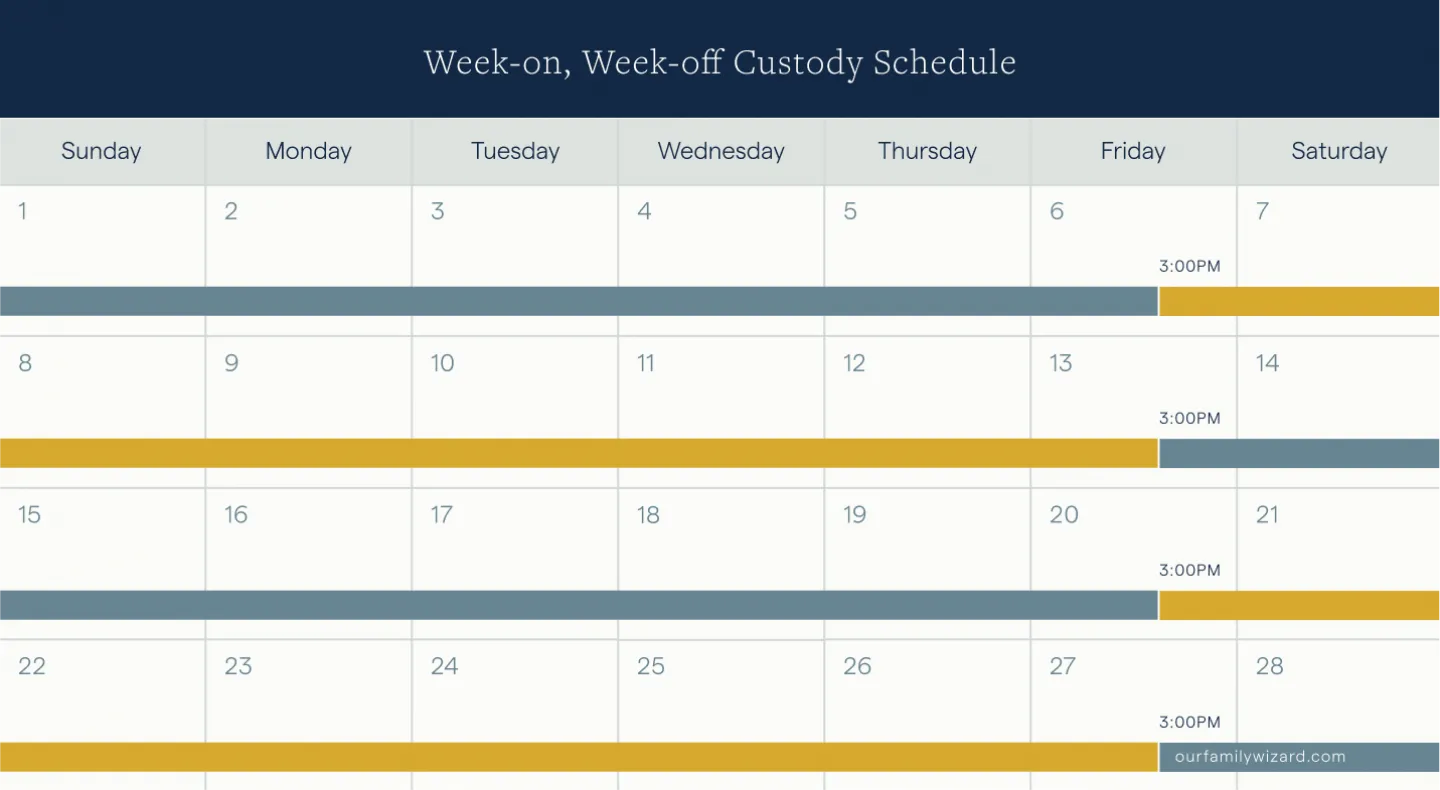
Month view of the alternating weeks parenting plan
The alternating weeks parenting plan splits up parenting time in one-week intervals. Here, the children spend one week with one co-parent and then one week with another. This classic schedule offers a simple, easy-to-manage schedule. Also, the week-long stays give parents and children ample time with one another, so the child is able to settle in on a deeper level. However, the plan presents challenges for co-parents with very young children, who may struggle with a week apart from either co-parent.
For example, Marcus might go to one parent's home on Friday after school and stay until the next Friday after school. That gives the parent 7 overnights before Marcus spends the next 7 at the other home.
Alternating weeks works best for pre-teens and teenagers who already have relationships with both co-parents and have an active life outside of family time. In general, most co-parents enjoy less frequent changeovers and extended time together. Fewer exchanges also mean fewer conversations you have to have with your co-parent, which can help if communicating is hard. Still, this schedule isn't the easier choice for every child or family.
Zeiderman describes how families often set up this schedule:
"Another popular 50/50 plan is alternating weeks, starting on Friday after school so that the child has the weekend to adjust to the transition. Usually, we also have a mid-week dinner for the parent who does not have the week so that the child is not going so long without seeing a parent."
Uncommon 50/50 parenting schedules
Atypical 50/50 parenting schedules can work for some families. For example, some families may choose to alternate custody every two weeks. Other co-parents add a midweek overnight to a 7-7 schedule. These uncommon arrangements can be harder on families because they either introduce complicated logistics or keep children away from a co-parent for too long.
Here's a summary of three uncommon 50/50 rotations.
Every two-weeks alternating custody schedule
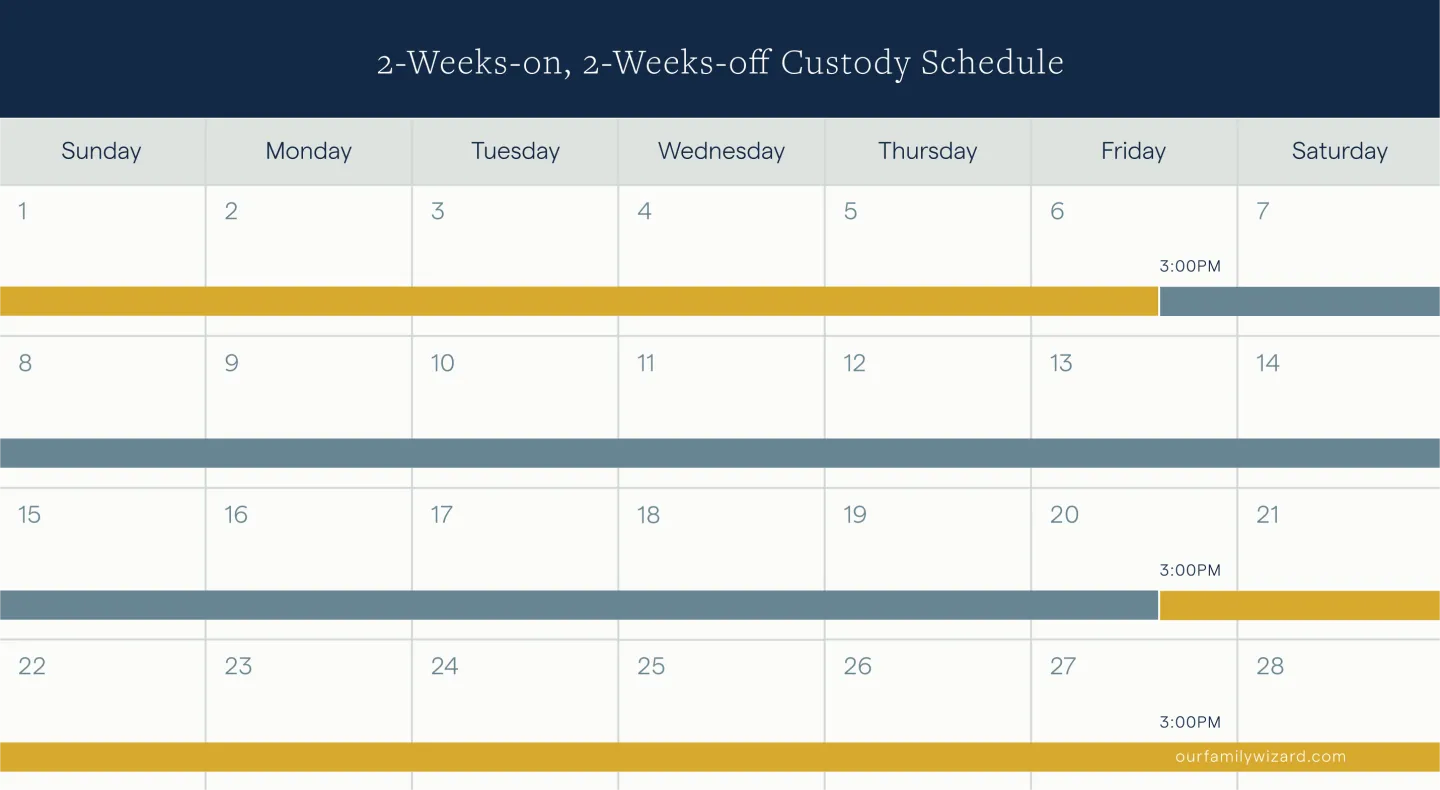
Month view of the two-week alternating schedule
In this schedule, co-parents alternate custody on a 2-week basis. This schedule is extremely rare because two weeks away from a parent will even stress a teenager. This schedule would be particularly challenging during the school year.
Every extended weekend with 3rd party time custody schedule
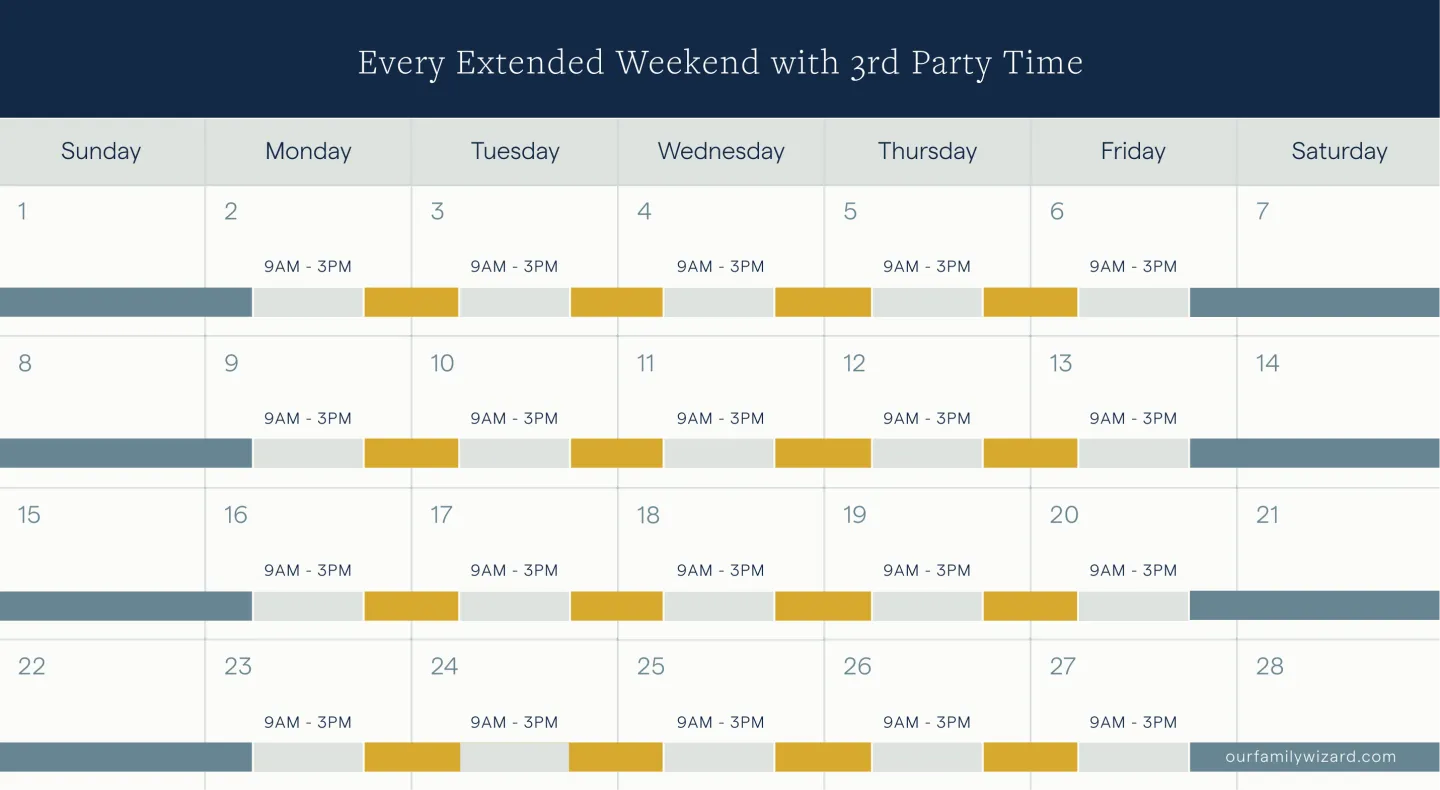
Month view of an every extended weekend schedule with 3rd party time
The every extended weekend schedule is a version of the 4-3 custody schedule that starts on Monday. Here, one co-parent has the child for four overnights (Monday–Thursday), and the other co-parent has the children for a long weekend (Friday–Sunday).
Some families find that when they consider third-party time, such as when the child is at daycare or school, the schedule evens out to a 50/50 split. Whether or not this will work for you depends on your work schedules, and your children’s school and extracurricular schedules. This split is uncommon but can work for families that agree to 4-3. However, it will only work if co-parents can track quality time very accurately.
Every extended weekend with a midweek overnight custody schedule

Month view of an every extended weekend schedule with a midweek overnight
In the every extended weekend schedule, one co-parent that usually takes the children on the weekends can add in a midweek overnight every other week to approximate a 50/50 split. Over two weeks, the weekend parent has 3 + 3 weekend overnights plus 1 midweek overnight, or 7 of 14.
This schedule is also rare and demands that co-parents track quality time together very accurately.
What is the best 50/50 custody schedule?
The best 50/50 custody schedule is the one that helps the children the most and causes the least stress for the co-parents. No single schedule will work for every family. Each family should look at their situation and choose a schedule that best meets their children's needs.
"A 50/50 schedule looks great on paper, but the real question is whether it works for your family's actual life: your kids' ages, your work schedules, and how close you live to each other," says Erin Levine, family law attorney and founder & CEO of Hello Divorce.
Levine adds, "The schedule is a tool, not a trophy. The best one is the one your children barely notice because it just feels like home."
How to pick the best 50/50 rotation for your family
Co-parents should prioritize the rotation that best fits their child's needs. Dr. Saini advises looking at your child's ages and stages of development when selecting a rotation. Then, consider whether both co-parents can logistically support a given schedule.
Here's an overview of the most common 50/50 schedule options to help you compare and choose:
Ideal fit lists the child ages (by school grade) and family conditions each schedule suits.
Best 50/50 schedules for different families
| Schedule | Benefits | Challenges | Ideal fit |
|---|---|---|---|
| 2-2-3 | Children regularly interact with both parents | Frequent exchanges Parenting days of the week change | Very young and young children (Newborns – PreK) Co-parents communicate well Co-parents live near one another Co-parents with stable work schedules |
| 3-4-4-3 | Children regularly interact with both parents Parents have same days each week, apart from the exchange day | Structured schedule with only one exchange day Can be difficult to split weekend time | Younger children (Kindergarten-8th grade) Co-parents communicate well Co-parents live near one another Co-parents with stable work schedules |
| 2-2-5-5 | Co-parents have the same days every week Both co-parents have weekend time | 5 days apart may be too long for some children | Younger children (Kindergarten-8th grade) Co-parents communicate well Co-parents live near one another Co-parents with stable work schedules |
| Alternating Weeks | Very simple, structured plan Co-parents have same days every week, including weekends | Co-parents and children spend up to a week apart Co-parents must share weekly extracurriculars | Pre-teens and older (8th – 12th grade) Co-parents communicate well Co-parents live near one another Pre-teen aged children and older Co-parents with stable work schedules |
| Every Two Weeks Alternating | Very simple, structured plan Co-parents have same days every week, including weekends | Co-parents and children spend up to two weeks apart May be difficult during the school year | Older teenagers (9th – 12th grade) Child can handle going long periods without seeing one parent Co-parents with stable work schedules |
| Every Extended Weekend with 3rd Party Time | Co-parents have same days every week, including weekends Includes scheduled time for third-party activities | Complex plan with lots of transitions | Younger children (Kindergarten-8th grade) Co-parents communicate well Co-parents live near one another Co-parents with stable work schedules |
| Every Extended Weekend with a Midweek Overnight | Co-parents have same days every week, including weekends | Tracking parenting time can be difficult Co-parents must share weekly extracurriculars | Very young and young children (Newborns – PreK) Co-parents communicate well Co-parents live near one another Co-parents with stable work schedules |
Suggested 50/50 custody schedules by age
Young children often do better with frequent exchanges, while teenagers can usually handle longer times apart. Therefore, Zeiderman recommends that families with young children start with 2-2-3 and work up to alternating weeks as the children age.
Ages 0–5 covers newborns through pre-K, Ages 6–12 covers kindergarten through 5th or 6th grade, and Ages 12–18 covers 6th through 12th grade. A check mark (✓) shows the age group each schedule suits.
Best 50/50 custody schedules for different ages
| Schedule | Ages 0–5 | Ages 6–12 | Ages 12–18 |
|---|---|---|---|
| 2-2-3 | ✓ | ||
| 3-4-4-3 | ✓ | ||
| 2-2-5-5 | ✓ | ||
| Alternating Weeks | ✓ |
Attorney Zeiderman shares her recommendations for the best custody schedules per age group:
Newborns and toddlers (pre-K)
"For very young children, we often start with a 2-2-3 schedule," says Zeiderman.
Her recommendation stems from the idea that young children and babies need a consistent routine. They also should interact with both parents meaningfully to form secure, healthy attachments. For a toddler, keep the same bedtime routine, comfort item and exchange time in both homes so frequent moves feel predictable.
If a newborn is breastfeeding, co-parents can build the schedule around feeding needs.
Kindergarten-6th grade (ages 5-12)
"Between kindergarten and 2nd or 3rd grade, we recommend the 5-2-2-5," says Zeiderman.
The 5-2-2-5 (the same rotation as 2-2-5-5, started on a different day) provides easier logistics than the 2-2-3 but still gives children meaningful time with both parents without too much time apart. But the 2-2-3 may also still work, particularly for younger children in this group.
"If elementary and middle-school children want less transitioning, we move to the alternating weeks schedule," Zeiderman says. However, co-parents usually keep their kids on a 5-2-2-5, or 3-4-4-3, until they're around 11 or 12 and can articulate well-formed opinions.
6th grade through high school (tweens and teens)
Zeiderman notes that around 11 or 12, children can usually articulate well-formed opinions. You can take their input to heart and ask them why they prefer a particular rotation.
"For teens, the alternating weeks schedule works well, so long as the parents are true joint custodians and can accommodate this schedule," Zeiderman says.
Teenagers may prefer the alternating weeks schedule because it minimizes how much time they spend moving from home to home. Around this time, your children will begin to prioritize their own social circles and extracurricular activities. Plus, teenagers will already have formed relationships with both co-parents and can probably handle longer times apart from each co-parent. At this stage, your teenagers will want to feel more in control of their schedule and may resent any rotation that doesn't provide them with ample flexibility and independence.
Use these recommendations as a starting point. The guidelines should never outweigh the specific needs of your child. Also, make sure that the rotation is realistic. There's no use in selecting the perfect rotation for the child if one or both co-parents cannot keep up with its demands.
50/50 custody schedule templates
Free 50/50 custody schedule templates let you see how each rotation looks on a real calendar before you agree to it. Download the version that matches the schedule you're considering and fill in your own dates.


50/50 custody schedule ideas
A 50/50 custody schedule can take different forms, such as alternating weeks, 2-2-3 or 2-3-2 (a version of 2-2-3). Another option is a week-on/week-off schedule with a midweek overnight visit. Consider the child's age and schedule, proximity of the homes, and work schedules.
Download our cheat sheet on all possible 50/50 custody schedule rotations
Easiest way to track 50/50 custody schedules
Many co-parents want to share family time but have difficulty organizing their schedules together. Lean on the OurFamilyWizard app for help. It keeps communication lines open, clear, and documented, so nothing gets lost in translation.
The shared co-parenting calendar, part of the OurFamilyWizard app, puts both parents' schedules in one shared parenting time calendar. It also has other features that help you co-parent together. For example, you can send your co-parent secure messages, track expenses and reimbursements, share photos and files, and much more.
Any good parenting plan should have room for flexibility. The schedule change request tool in the app provides a simple, straightforward way to request changes to the schedule. Use it whether you want an extra dinner with your children or need to accommodate a sudden shift in your work schedule. It has you covered for schedule changes, holiday plans, and more.
When the app keeps your schedules in sync, you can put your energy into parenting together and into what matters most: Raising healthy, happy children.
Choosing a 50/50 custody schedule that works for your kids
The best 50/50 custody schedule fits your child's age, the distance between your homes, both parents' work schedules and how well you keep conflict low. As your child grows, the right rotation may change, too.
A parenting plan is the foundation of any custody arrangement. It spells out the schedule and how exchanges work, so both homes follow the same routine and your child knows what comes next.
Before you commit, your attorney can use the custody schedule builder to show you how different rotations look on a calendar. If you have questions about how a schedule fits your situation, talk to your family law attorney for advice and next steps.
50/50 co-parenting schedule FAQs
People often have questions about 50/50 schedules. For example, you may wonder which schedule is most popular or works for younger children. Also, some co-parents who live far from one another wonder if they can make the 50/50 rotation work.
What is the most popular 50/50 schedule?
Attorney Lisa Zeiderman names 5-2-2-5 (the 2-2-5-5 rotation started on a different day) and alternating weeks as the two most popular 50/50 schedules. Both have longer stretches than 2-2-3 but need less week-to-week coordination.
Which 50/50 custody schedule is best for toddlers?
Zeiderman says families with very young children often start with 2-2-3 because it keeps time apart from either parent to three days or less. That frequent contact helps toddlers build secure relationships with both parents.
Which 50/50 custody schedule is best when there is a long distance between co-parents' houses?
50/50 schedules are hard to sustain when homes are far apart, though alternating weeks can work because it needs only one exchange a week. If that still doesn't fit your child, talk to your family law attorney about whether a 60/40 or 70/30 split makes more sense.
Which 50/50 custody schedule is best for summer?
It depends on your child's age and summer plans. You can switch to a summer rotation with longer blocks around camps and trips, as long as each parent still has regular time with your child.
What age is best for week-on/week-off custody?
Zeiderman says alternating weeks works well for teens, as long as both parents can accommodate it. Tweens can often handle a week apart and often want fewer moves between homes.
Who is responsible for the 50/50 custody schedule?
Both co-parents share responsibility for choosing, following and adjusting the 50/50 custody schedule. Your parenting plan should spell out how you'll agree on changes.
Do you still pay child support with 50/50 custody?
It can: In some states, equal time doesn't automatically end support, and New Jersey's child support guidelines, for example, say the higher-earning parent may owe support when parenting time is near equal. Ask your family law attorney how your state's formula applies to you.
Is joint custody the same as 50/50 custody?
Not necessarily. In California, the Courts Self-Help Guide explains that custody is made up of legal custody and physical custody, so parents can share decisions without splitting time exactly in half.
How many overnights does each parent get with 50/50 custody?
In any equal rotation, each parent has 7 of every 14 overnights, or about 182 to 183 nights a year. Holiday and summer schedules can shift that count, so track it on your shared parenting time calendar.
*Educational podcast generated by Google NotebookLM