3-4-4-3 Custody Schedules (3443): Benefits, Challenges, and Expert Tips

A 3-4-4-3 custody schedule splits time 50/50 over two weeks, so kids are never more than four days from either parent. See who it fits and get a free template.
Choosing a 50/50 schedule means picturing your child’s week in two homes. This guide explains how a 3-4-4-3 custody schedule works and which families it fits, with tips from family law experts and a free template.
Key takeaways
- The 3-4-4-3 is one example of a 50/50 schedule where parents have equal time with the kids over a two-week period.
- Co-parents who want to use the 3-4-4-3 schedule should live near one another and maintain a relaxed, healthy relationship.
- Under 3-4-4-3, kids and parents will go only four days maximum without seeing each other.
- Co-parents can choose to start the 3-4-4-3 schedule on Sunday, so both get a weekend day with the kids.
- A shared co-parenting calendar helps co-parents stick to the schedule, communicate well, and request any changes.
What is a 3-4-4-3 custody schedule?
A 3-4-4-3 parenting schedule is a shared parenting model where co-parents alternate between three- and four-day periods with their children. Some co-parents modify the schedule for weekends and special occasions like holidays. You may also see it written as a 3443 custody schedule.
You’ll often see the 3-4-4-3 schedule rotation referred to as a “custody schedule” or a “parenting schedule.”
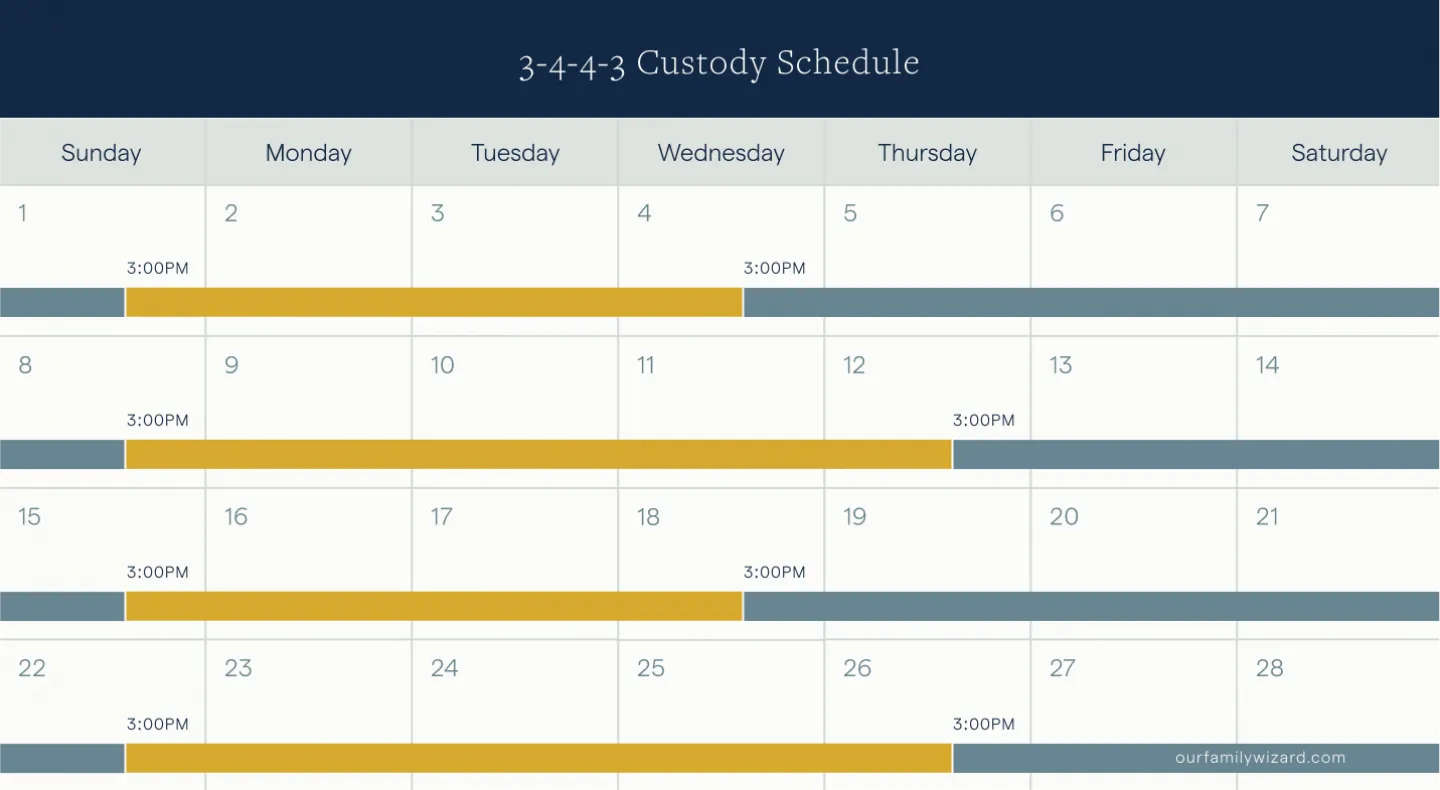
Create a personalized 3-4-4-3 custody schedule template
According to a 2022 study in Demographic Research, the likelihood of shared physical custody after divorce in the United States more than doubled, from 13% before 1985 to 34% in 2010–2014. In fact, in a review of 40 studies published in the Journal of Divorce & Remarriage, Dr. Linda Nielsen writes that, in studies comparing children who spent at least 35% of their time with each parent, “children in shared parenting families had better outcomes on measures of emotional, behavioral, and psychological well-being, as well as better physical health and better relationships with their fathers and their mothers.”
Of course, 50/50 arrangements introduce new complications that parents with other schedules don’t need to consider. Instead of one house being the dominant residence, parents with shared physical custody must navigate the logistical challenges of frequent exchanges. For all 50/50 schedules, the parents should live near one another and communicate well.
But, apart from these universal requirements, different templates accommodate other needs or limitations. Every co-parenting arrangement needs a parenting plan, and selecting the right parenting plan is the foundation of a smooth transition.
Co-parents who want a consistent schedule may favor the 3-4-4-3 schedule. The 3-4-4-3 schedule has two exchanges a week (four over the two-week cycle), and only one falls midweek. That’s fewer than the six exchanges every two weeks in a 2-2-3. The schedule may not be ideal when the co-parents have a strained relationship and aren’t willing to change the schedule around weekends and holidays.
 Jennifer L. Lavin, Ph.D., J.D., describes the 3-4-4-3 as a balance between minimizing both time away from children and excessive rotations. “The 3-4-4-3 schedule provides for equal parenting time for both parents without what some parents may consider to be overly large gaps in time (e.g., a 5-2-2-5 schedule,)” notes Lavin. She also points out that the schedule “provides a rotation for parents who don’t want their parenting days limited to certain days of the week.”
Any co-parents considering 50/50 custody should read on to learn more about the 3-4-4-3 schedule.
How does a 3-4-4-3 parenting schedule work?
In a 3-4-4-3 parenting schedule, the first parent has the kids for three overnight visits, and then the second has them for four. Next week, the days swap: The first parent has the kids for four days, and the second has them for three.
If you start on Sunday, Parent A has Sunday through Tuesday in week one and Parent B has Wednesday through Saturday. In week two, Parent A has Sunday through Wednesday and Parent B has Thursday through Saturday. Wednesday is the only day that changes hands. If Maya has piano on Mondays, the same parent takes her every week.
Week | Parent A | Parent B |
|---|---|---|
Week 1 | Sunday–Tuesday (3 overnights) | Wednesday–Saturday (4 overnights) |
Week 2 | Sunday–Wednesday (4 overnights) | Thursday–Saturday (3 overnights) |
Two-week total | 7 overnights | 7 overnights |
Sometimes, people confuse the 3-4-4-3 schedule with the 3-4 schedule, which is a 60/40 schedule where one parent has the kids for 60% of the week, and the other has them for 40% of the week. To easily distinguish between the two, follow the numbers in the schedule. Like all custody schedules, the numbers in the title refer to the number of days each parent has the children for.
For the 4-3 schedule, the first parent in the rotation is with the kids for four days, and the other parent is with them for three. Then, the schedule restarts. In this case, the schedule never switches, and each parent has the kids for the same days every week.
For 3-4-4-3, the first parent is with the kids for three days, and the other parent is with the kids for four (3-4-4-3). Moving forward, the first parent gets the kids for four days and the other parent for three (3-4-4-3). Over two weeks, the kids get equal time with both parents.
Compared with other 50/50 schedules, the 3-4-4-3 provides a high level of consistency. Parents coordinate two exchanges a week (four over the two-week cycle), fewer than the six exchanges every two weeks in a 2-2-3. This format creates an easy-to-remember schedule with only one mid-week transition day. Parents can start the schedule on any day to better split weekends.
For example, beginning the schedule on Sunday morning gives each parent a weekend day with the kids. Of course, parents can choose to add their unique flair to the calendar. For example, some add alternating weekend arrangements so that each parent can enjoy a long weekend with the kids.

A note on custody terminology
In general, the term “physical custody” refers to which parent a child lives with. Today, many experts use other terms to describe this arrangement, like “parenting schedule” or “parenting time arrangement.” These new terms better represent a relationship and the parent’s responsibilities for their children. But just a heads up: This article uses these older and newer terms interchangeably.
Who is a 3-4-4-3 child custody schedule good for?
Organized parents who thrive under a consistent schedule and live near one another do well under a 3-4-4-3 schedule. Also, children who don’t want to be apart from either parent for long benefit from the 3-4-4-3 rotation.
“A 3-4-4-3 schedule works well for co-parents who have an amicable relationship, stable work schedules, and whose children are adaptable to a rotation schedule,” Lavin says. “This schedule may not work well for co-parents whose work schedules are variable, and whose children need more regularity in terms of scheduling.”
Here’s a breakdown of the families that may excel with a 3-4-4-3 schedule. Note that some of these considerations may change as a child grows older.
Co-parents who live near one another
The 3-4-4-3 schedule requires two exchanges a week (four over the two-week cycle), and only one falls midweek. These exchanges may sound simple but can be challenging if you and your co-parent live more than 10 to 15 miles apart. In this case, commuting becomes a significant hassle and can negatively affect parents, children, and caregivers.
Also, the kids will need to bring schoolwork and other personal items from home to home. Even the stress of just remembering what to pack can burden a young child. It’s inevitable: More than once, someone will forget to pack an important item. If you and your co-parent live nearby, this problem may not escalate into a big deal. On the other hand, if a forgotten piece of schoolwork creates a headache for one parent, your child may feel stressed or guilty and fall behind in schoolwork.
For any 50/50 arrangement, kids whose parents live near the same bus stop or in the same school district will experience fewer disruptions to their schedules and adjust better.
Co-parents with stable work schedules
 “The traditional 3-4-4-3 schedule has each parent having the same days each week with the exception of one alternating day,” notes Danielle Kestnbaum J.D., M.S.W. “This can be beneficial to parents who have different work schedules that might enable them to cut down on childcare costs where, as an example, one parent has Mondays off while the other has Saturdays off.”
Also, many parents choose to split the schedule during the school week. If both you and your co-parent have strict job schedules with little time off, a midweek, after-school exchange will be stressful without outside help. At the same time, if your job schedules are variable (one of you is an on-call doctor, for example), you may have difficulty sticking to the routine.
You can mitigate scheduling problems if you and your co-parent live near one another and the kids attend school. In this case, the kids can take the bus in the morning from one parent’s house and then take the bus back to their other parent’s house, making the exchange simple and low-stress.
Co-parents with relaxed, cooperative relationships
The consistency of the 3-4-4-3 schedule can benefit parents. For example, suppose your child has recitals every Monday and football games every Thursday. In that case, you can plan exchange days such that the responsible parent for each extracurricular activity is kept consistent.
However, this consistency also can create issues, as Kestnbaum points out: “The traditional 3-4-4-3 is not ideal in situations where the co-parents’ relationship is strained to the point that the co-parents are unable or unwilling to attend extra-curricular events together. Because in such instances, one parent might miss all football games if the football games are on the same day each week and it’s the day that the other parent has the children.”
Preschool and school-age children who handle four days apart
Four-night stretches are long for toddlers. For children ages 2–3, the Arizona Supreme Court’s parenting time guide says, “Ideally, a child this age shouldn’t be separated on a regular schedule from either parent for longer than three days.” That’s why a 2-2-3 custody schedule, which is also a 50/50 split, is usually the better fit for toddlers.
A Swedish study of 3,656 children ages 3–5, published in Acta Paediatrica, found that joint physical custody was not linked to more psychological symptoms than living mostly with one parent.
For school-age children, the same guide notes that “children differ in how long they are comfortable being away from each parent.” Its split-week plan fits a child who can be apart from either parent for three or four days. If your 7-year-old has soccer every Monday, the same parent takes them every week, so the soccer routine stays the same.
Likewise, older children who already have formed secure attachments to their parents will not want to be away from either parent for too long. In this case, the 3-4-4-3 schedule facilitates a healthy attachment style and fosters secure relationships that have already formed.
Pros of a 3-4-4-3 joint custody schedule
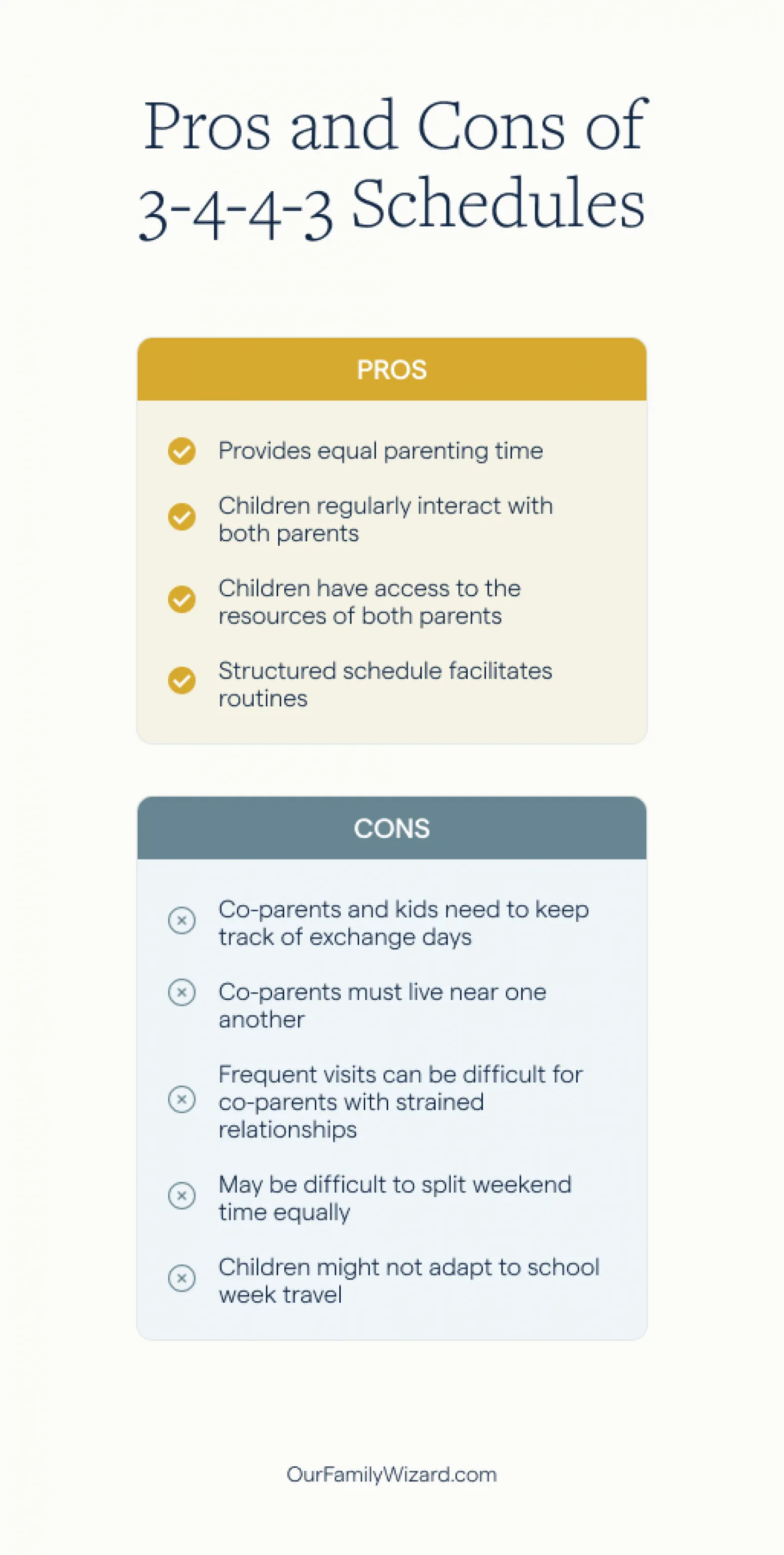
Many co-parents like the 3-4-4-3 schedule because it doesn’t keep kids apart from either parent for too long, helping them form healthy relationships with both parents. Also, having only one midweek exchange helps everyone maintain their routines.
Here’s a summary of the pros of adopting this parenting schedule.
Frequent contact between co-parents and kids
Under the 3-4-4-3 schedule, a parent and child never go more than four days apart, which keeps both relationships part of the child’s ordinary week. For parents that want to play an active role in their children’s lives, shared schedules like 3-4-4-3 make it clear that both parents have equal time and opportunity.
Structured custody schedules and minimal exchange days
In many cases, parenting schedules compromise on either frequent contact or structured routines. For example, in the common 2-2-3 schedule, parents and kids go only a maximum of three days without seeing one another. However, that schedule demands more frequent exchanges.
3-4-4-3 attempts to minimize the number of exchanges as well as time spent apart. Co-parents keep track of two exchanges a week (four over the two-week cycle), and only one falls midweek. That’s fewer than the six exchanges every two weeks in a 2-2-3. Plus, except for the midweek exchange day, the days each parent cares for the children won’t change. As a parent, this gives you the time to organize your social life and other commitments while minimizing confusion about which parent is responsible for your kids’ activities.
Plus, many of the benefits of a 3-4-4-3 schedule overlap with those of other types of shared schedules. These benefits include:
- Children have access to the extended family and resources of both parents
- Each parent can impart their unique parenting style and experiences
Cons of a 3-4-4-3 joint custody schedule
Co-parents who live far away from one another will find the logistics of the 3-4-4-3 schedule difficult to manage. Sometimes, only one parent has the kids for the weekend, which can create tension and stress. For children, switching homes during the school week can be difficult.
Here are the challenges with a 3-4-4-3 schedule:
- “Parents whose work schedules are variable may be challenged by the 3-4-4-3,” Lavin says, “because there is no guarantee that these parents would not have work obligations that conflict with their desired parenting times.”
- Can create a tense co-parenting environment if one parent has the kids for the entire weekend.
- School-aged children may find midweek exchanges difficult.
- Parents must live near one another.
Examples of a 3-4-4-3 parenting schedule
You can customize the 3-4-4-3 schedule to serve your unique scheduling needs and maintain a 50/50 split. To better understand your options, check out different variations of the 3-4-4-3 schedule, like 3-3-4-4 and 4-3-3-4.
You can start on any number in the 3-4-4-3 series and still maintain the same 50/50 split. These schedules maintain an equivalent number of days per parent as 3-4-4-3, but they start on different days of the rotation.
The examples in this article show you what these different starts typically look like. You can experiment with different layouts in the OurFamilyWizard Calendar, or your attorney can use OurFamilyWizard’s Custody Schedule Builder (available for family law professionals) to quickly and easily show you what custom 3-4-4-3 custody schedules look like.
3-3-4-4 custody schedule
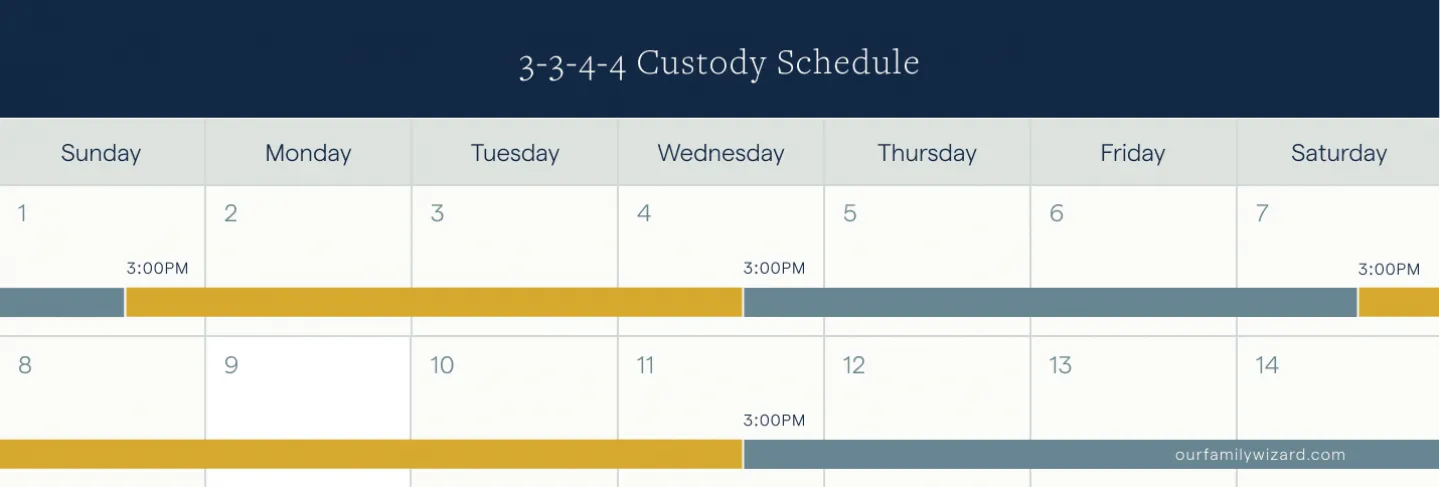
One parent has three days, then the other parent has three. Next, the first parent has four days and the other parent has four.
In most cases, parents start the plan on Sunday, making Saturday the only day that varies per week. This rotation ensures that both parents get a weekend day with the kids.
4-3-3-4 custody schedule
As the title suggests, the 4-3-3-4 is the inverse of 3-4-4-3. Instead of the first parent in the rotation starting with three days, the first parent starts with four. Then, the other parent gets the children for three days. At the start of the second week, the first parent gets the children for three days, and the other parent gets them for four days.
Like the 3-4-4-3 schedule, 4-3-3-4 will give only one parent the entire weekend, unless both co-parents agree on alternating weekend visits or choose to start the schedule on a day besides Monday. For example, if both co-parents agree to start the schedule on Sunday, each co-parent will have a weekend day with the kids.

4-4-3-3 custody schedule
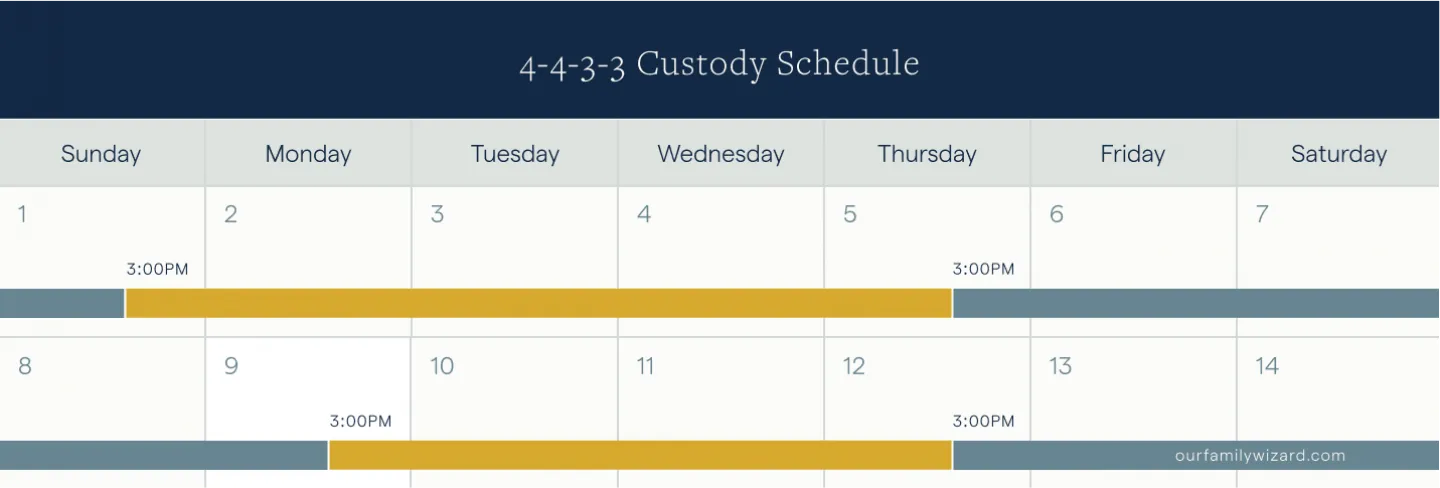
The 4-4-3-3 splits time with the kids into two repeating four-day and three-day intervals. If you start the schedule on Sunday, each parent will have a weekend day every other week.
For example, the first parent has four days, from Sunday afternoon through Thursday afternoon. Then, the other parent has four days, from Thursday afternoon through Monday afternoon. Now, the first parent has Monday to Thursday, and the other parent has Thursday through Sunday afternoon.
Free 3-4-4-3 custody schedule template
Use our free 3-4-4-3 custody schedule template to picture what the parenting schedule may look like for your family. Experiment with different exchange days and variations to determine which rotation will fit your family best.


Alternatives to a 3-4-4-3 parenting schedule
Alternating weeks, two-week rotations, and 2-2-5-5 schedules also give each parent 50/50 time, with longer stretches in each home. For example, parents looking for more structure may prefer the alternating weeks or two-week custody schedules.
Here are other 50/50 parenting schedules that co-parents commonly use.
Alternating weeks (7-7 schedule)
In the alternating weeks schedule, each parent spends a whole week with their children at a time. Consequently, parents and children go seven days at a time without seeing one another. In many cases, parents add in a visit here or there to the alternating week schedule, like alternating weeks with one mid-week overnight stay at the other parent’s house.
Because exchanges happen once a week, alternating weeks can reduce how often parents who struggle to communicate need to coordinate, though seven days apart is a long stretch for some children.
Two-week custody schedule
Co-parents who live far apart may prefer the two-week custody schedule. Under this rotation, kids stay with each parent for two weeks. However, two weeks may be too much time apart for many children.
2-2-5-5 custody schedule
For families using the 2-2-5-5 custody schedule, the first parent has the kids for two days, then exchanges with the other parent for another two days. After that, the first parent has an entire five days with the kids, and the other parent gets the next five days.
Questions to ask when considering a 3-4-4-3 parenting schedule
Ask questions together as a family to decide between a 3-4-4-3 schedule or alternatives. For example, you and your co-parent should discuss whether you can handle having to see each other at least once a week. Also, discuss the potential effects of weekly parenting time exchanges on the children.
Here are some questions that family experts advise co-parents to discuss before jumping into the 3-4-4-3 schedule:
- “Will there be logistical challenges because of a midweek transition?,” asks Kestnbaum. “These challenges can be related to the parents’ geographic distance from one another or the children’s schools. Or maybe the children will have difficulty remembering needed school supplies or projects in progress.”
- “Do the co-parents have a relationship where they can both comfortably attend extracurricular activities?” Kestnbaum says that’s another important question co-parents should discuss. “There may be instances where an important activity routinely falls on the same day each week, on a day that is always reserved for a specific parent. Such activities and schedules might be unknown at the time the co-parents create their schedule. So, it’s important for parents to ask themselves how it will work for both to be involved and how this arrangement might make them feel.”
If one parent always has Thursdays, write into your parenting plan that the other parent can still attend Thursday games, so you never have to argue about it.
Lavin advises parents to consider the following:
- “Is a 3-4-4-3 schedule practical given our work schedules?”
- “Does a 3-4-4-3 schedule fulfill the unique needs of our children? Will the schedule continue to remain practical as our children grow?”
- “Will all or portions of our holiday parenting times need to be planned on a separate schedule?”
Other questions should include:
- Do the co-parents live near one another (ideally within 10-15 miles)?
- Are kids comfortable in both homes?
- Are other caregivers or family members nearby to help if an unanticipated event creates an issue in the schedule?
- Are the kids young and still forming their attachments to each parent? Will they need equal time with both parents to form secure attachments and healthy relationships?
Simplify your 50/50 custody schedule
Keep your co-parenting organized with OurFamilyWizard.
Easiest way to manage a 3-4-4-3 custody schedule
A shared custody calendar that both parents can see is the easiest way to keep a 3-4-4-3 rotation on track. OurFamilyWizard’s shared custody calendar and communication tools help make shared parenting time schedules much easier to handle.
“A shared electronic calendar is helpful in enabling co-parents to stay organized and minimize conflict,” Kestnbaum says. It should be “easy to read and visualize the parenting schedule as well as holidays and events like doctor appointments, birthday parties, and recurring extra-curriculars.”
She adds: “This type of calendar is especially helpful if it includes access to customer support as questions often arise around calendar entries, changes to the entries, and even getting the parenting time and events put in correctly.”
OurFamilyWizard’s shared custody calendar tool has all the features you need to keep your family in sync with the 3-4-4-3 schedule. Requesting extra weekend time or navigating the holidays will be stress-free with tools like schedule change requests and a holiday scheduler. The single shared parenting schedule builder minimizes conflict, improves communication, and alleviates stress by keeping co-parents on the same page every week.
Is a 3-4-4-3 custody schedule right for your family?
A 3-4-4-3 custody schedule tends to work best when you live near your co-parent, you both have steady work schedules, your child is school age, and you can cooperate around activities. Whatever rotation you choose, every co-parenting arrangement needs a parenting plan that spells out the details.
3-4-4-3 custody schedule FAQs
Here are quick answers to common questions about the 3-4-4-3 custody schedule.
How can I implement a 3-4-4-3 custody schedule with minimal conflict?
Explain that a 3-4-4-3 schedule is a 50/50 split with a predictable pattern that keeps children close to both parents. If conflict continues, consider working with a family therapist, parenting coordinator, or mediator.
Can a 3-4-4-3 schedule be court-ordered, or does it require parental agreement?
A judge may order a 3-4-4-3 schedule even if one parent disagrees, or parents who agree can ask the court to approve their plan; talk to your family law attorney about how this works where you live.
Can the 3-4-4-3 schedule be customized for holidays, school schedules, and extracurriculars?
Yes, you can plan holidays, school breaks, and extracurriculars separately from the main 3-4-4-3 schedule. For example, if it’s your year for Christmas, you’d have the children that day even if it falls during your co-parent’s regular time.
Is a 3-4-4-3 pattern a popular custody schedule?
A 50/50 split is very common, but the 3-4-4-3 pattern is less common than 2-2-3, 2-2-5-5, and every other week. Still, it might suit your family because it splits each week in half nearly equally.
Is 3-4-4-3 considered joint custody?
A 3-4-4-3 schedule splits parenting time 50/50, so it may be considered joint physical custody, though terms vary by state.
Is a 3-4-4-3 pattern good for kids?
It can be, for children old enough to handle four days apart: Nielsen’s 2014 review of 40 studies found children in shared parenting families had better outcomes on several well-being measures, though the right schedule depends on your child.
Is a 3-4-4-3 custody schedule the same as a 4-3 schedule?
No, there's a crucial difference: They're not both 50/50. The 4-3 schedule repeats a roughly 60/40 split every week, while a 3-4-4-3 alternates which parent gets four nights, so it is 50/50 over two weeks.
How many exchanges happen in a 3-4-4-3 custody schedule?
A 3-4-4-3 schedule has four exchanges every two weeks, or two a week. Only one exchange each week falls midweek, which is fewer than the six exchanges every two weeks in a 2-2-3.